

GHK-Cu and TB-500 get grouped together constantly, and the grouping is misleading. One is a three-residue
peptide carrying a copper ion. The other is a fragment of a 43-residue protein that controls how cells build their internal
skeleton. They are not variants of one idea — they are different classes of molecule doing unrelated things.
All products supplied by NexPept are intended for laboratory research use only. Not for human or veterinary use.
Nothing on this page describes, recommends or implies use in humans or animals.
The short answer
GHK-Cu is a metal complex. Its biology is inseparable from the
copper ion it carries, and most of its research literature concerns the extracellular matrix — the scaffolding
between cells.
TB-500 is a peptide fragment with no metal, and its literature
concerns actin — the protein cells use to build their internal skeleton and to move. That is work happening
inside cells.
Outside the cell versus inside the cell. That is the cleanest way to hold the difference, and almost everything else follows
from it.
| GHK-Cu | TB-500 | |
| What it is | Tripeptide–copper(II) complex | Fragment of thymosin beta-4 |
| Sequence | Gly-His-Lys + Cu2+ | Derived from a 43-residue protein |
| Contains a metal | Yes — copper is integral | No |
| Molecular weight | 401.9 g/mol | Depends on form (see below) |
| CAS number | 89030-95-5 | Varies by form |
| Occurs naturally | Yes — in human plasma | Parent protein does; the fragment is synthetic |
| Principal research area | Extracellular matrix | Actin and the cytoskeleton |
| Acts primarily | Outside cells | Inside cells |
| Appearance | Blue powder (copper) | White to off-white powder |
| Category | Cellular research — both |
What GHK-Cu actually is
GHK is three amino acids: glycine, histidine, lysine. On its own it is unremarkable. What makes it interesting is that this
particular arrangement binds copper(II) with high affinity, and the resulting complex — GHK-Cu — behaves as a single
functional unit rather than as a peptide that happens to have a metal nearby.
The copper is not a passive passenger. Copper is a required cofactor for several enzymes involved in building and
cross-linking the extracellular matrix, and it is also redox-active, meaning it can participate directly in electron-transfer
chemistry. A tripeptide that carries copper to a location is doing something a tripeptide alone cannot.
GHK occurs naturally in human plasma and in other fluids, which makes it an endogenous compound rather than a designed one.
That matters for how its literature reads: much of the work treats GHK-Cu as a signal the body already uses, and asks what it
does, rather than treating it as an invented molecule and asking whether it works.
Research areas cluster around extracellular matrix remodelling, collagen-related fibroblast signalling, copper transport and
copper-chaperone proteins, and gene-expression work. Our
GHK-Cu research overview covers the coordination chemistry and the
literature in depth.
What TB-500 actually is
TB-500 relates to thymosin beta-4, a 43-residue protein encoded by the TMSB4X gene with a molecular weight of about
4,921 g/mol. Thymosin beta-4’s defining function is actin sequestration: it forms a one-to-one complex with globular actin
monomers — G-actin — and binds G-actin but not filamentous F-actin.
That selectivity is the mechanism. Cells build their internal skeleton by polymerising G-actin monomers into F-actin
filaments, and dismantle it by doing the reverse. A protein that binds only the monomer acts as a buffer, holding a reserve of
building material and controlling how much is available to polymerise. Since cells move by continuously building and dismantling
actin, anything that regulates that pool bears on cell migration.
The sequence LKKTET, beginning at residue 17, is frequently described as the actin-binding motif, though published work
indicates the full protein length participates in the interaction rather than that motif alone. Our
TB-500 research overview goes further into this.
A naming caution specific to TB-500. “TB-500” is a commercial designation rather than a standardised
chemical name, and it is not used consistently across suppliers. In some catalogues it refers to a short synthetic fragment
built around the actin-binding motif; in others it refers to full-length thymosin beta-4. Those are different molecules with
very different masses, and a short fragment and a 43-residue protein will not behave the same way in an assay. Before relying
on material labelled TB-500, read the molecular weight on its certificate of analysis: full-length thymosin beta-4 lands near
4,921, while a short motif-based fragment comes in far lower. The COA settles it; the product name does not.
Why the comparison gets made at all
These two end up on the same list because both appear in literature described loosely as “tissue research,” and because
suppliers group them that way. The grouping reflects a shared research vocabulary, not shared biology.
A useful way to see the gap: GHK-Cu could not do what TB-500 is studied for, because it does not bind actin and has no
mechanism for doing so. TB-500 could not do what GHK-Cu is studied for, because it carries no copper and the copper is central
to GHK-Cu’s described chemistry. Neither is a substitute for the other in any experiment where the mechanism matters.
Choosing between them for a study
If your question concerns the matrix between cells — collagen and structural proteins, matrix remodelling, or anything
where copper availability is part of the system — GHK-Cu is the compound
whose literature matches.
If your question concerns what happens inside cells — actin dynamics, cytoskeletal organisation, cell motility or
migration assays — TB-500 is the one with the relevant body of work.
If the question is broader than either — a tissue-model system where several processes run at once — then the
honest answer is that using both tells you less than you would hope, because any observed effect cannot be attributed to one of
them. Separate arms are the correct design. The same reasoning applies to our
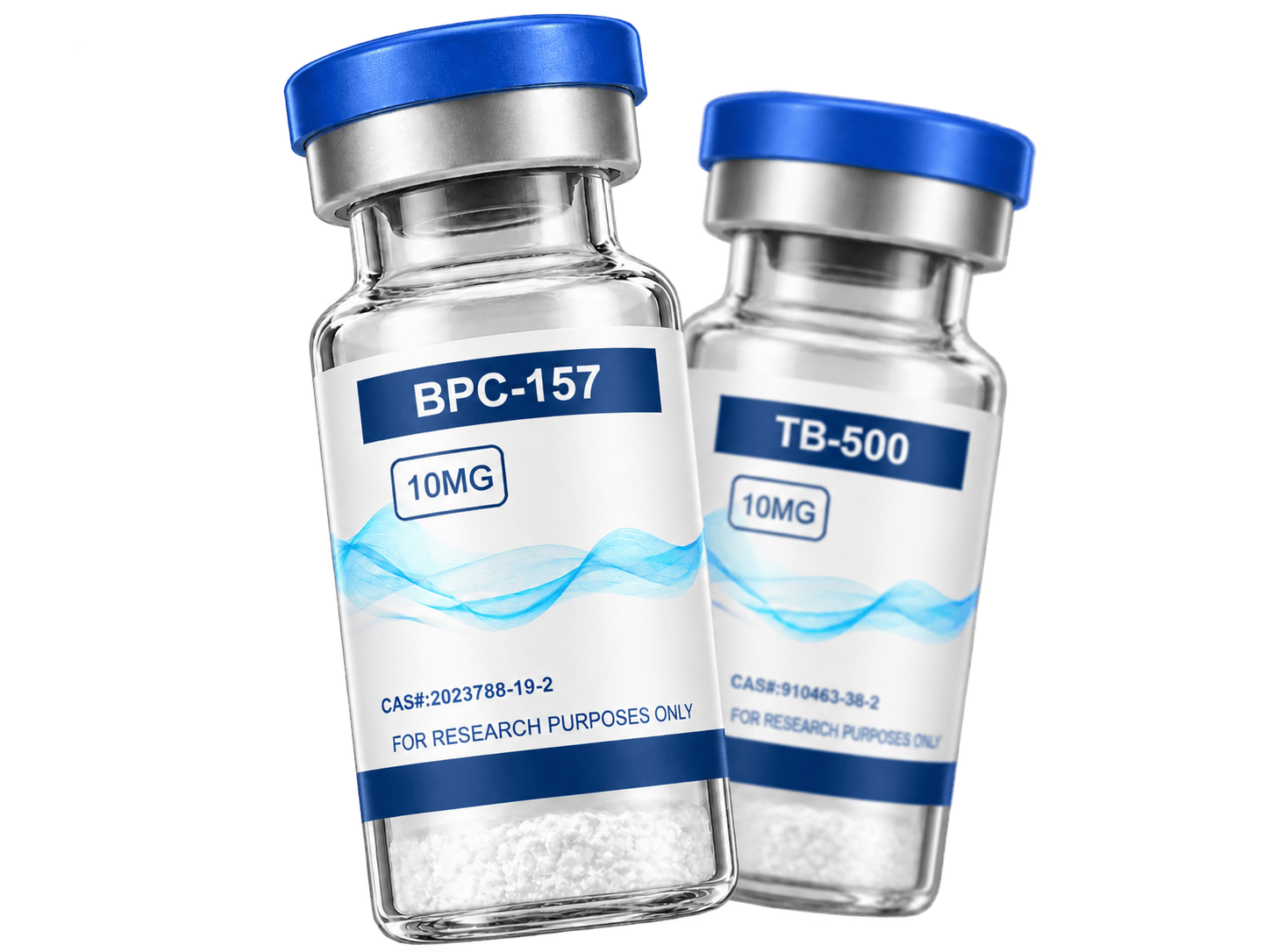
BPC-157 and TB-500 blend, and
our guide to peptide blends covers when a combined format is and is not
appropriate for controlled work.
Related comparisons
TB-500 is more often compared against BPC-157 than against GHK-Cu, since those two share more research vocabulary — our
BPC-157 vs TB-500 comparison covers that pairing, and the
Healing Blend overview covers the combined format. For
BPC-157 itself, the
BPC-157 research overview is the place to start.
Handling: where they differ
Both arrive as lyophilised powder, both are stable frozen and much less so reconstituted, and both should reach room
temperature before the vial is opened so moisture does not condense inside.
The practical differences come from the copper. GHK-Cu is a coordination complex, so anything that competes for the metal is a
variable: chelating agents and metal-containing buffers can disturb the complex in ways that do not apply to a metal-free
peptide. The blue colour of the powder is itself a copper signature, and an unexpected colour change is informative rather than
cosmetic. TB-500, carrying no metal, has none of these considerations.
For both: avoid repeated freeze-thaw cycling, aliquot into single-use volumes after reconstitution, and record lot numbers
against runs. Our guide to peptide stability covers
storage and degradation in more detail.
Verification
Both compounds are tested by an independent third-party laboratory by HPLC and mass spectrometry before a lot is listed, and
every report is published in the NexPept Certificate of Analysis library rather
than supplied on request after purchase.
Two checks matter more than usual for this pair. For TB-500, the molecular weight on the certificate tells you which form you
have, as described above. For GHK-Cu, confirm the certificate describes the copper complex rather than the bare GHK tripeptide
— those are different materials, and the peptide without its copper is not the compound the GHK-Cu literature is about.
Our quality standards page sets out how batches are tested,
what research peptides are explains how research-grade material differs
from a drug or supplement, and buying peptides in Canada covers what to check
before ordering.
Lyophilised powder, batch-tracked, third-party tested by HPLC and MS. Ships from Ontario with same-day dispatch on orders
placed before 2 PM EST.
Frequently asked questions
Are GHK-Cu and TB-500 interchangeable?
No, and not in a way that admits compromise. GHK-Cu is a copper complex studied for extracellular matrix
signalling; TB-500 relates to a protein that binds actin inside cells. Neither has a mechanism for doing what the other is
studied for.
Which one is “stronger”?
Not a question these two support. They act on different systems, in different compartments, by different
mechanisms. Ranking them by strength is like asking whether a wrench is stronger than a thermometer.
Why is GHK-Cu blue?
The copper. Copper(II) complexes absorb light in a way that produces a blue colour, so the shade is a
direct visual indicator that the metal is coordinated. A GHK preparation without copper is not blue, and an unexpected colour
change in a GHK-Cu sample is worth investigating rather than ignoring.
What exactly is TB-500 — the fragment or the whole protein?
It depends on the supplier, which is the problem. “TB-500” is a trade designation, not a standardised
chemical name; some catalogues use it for a short fragment built around the actin-binding motif, others for full-length thymosin
beta-4 at roughly 4,921 g/mol. Check the molecular weight on the certificate of analysis rather than trusting the product
name.
What does “actin-sequestering” mean?
Cells build internal filaments by joining actin monomers (G-actin) into chains (F-actin). Thymosin
beta-4 binds G-actin one-to-one but not F-actin, so it holds monomers in reserve and limits how much is available to polymerise.
That buffering is how it influences cytoskeletal dynamics and, by extension, cell movement.
Can I use both in the same experiment?
You can, but attribution suffers. If both are present and something changes, the experiment cannot tell
you which compound caused it. For any question about what an individual compound does, separate arms are the correct
design.
Are either approved in Canada?
No. Neither GHK-Cu nor TB-500 has Health Canada authorisation for any use. Both are supplied as
research compounds for laboratory use only and are not drugs, supplements, cosmetics or treatments.
How do I know I’m ordering from the real NexPept?
Our only website is nexpept. Sites using similar names are not affiliated with us. Confirm via our
website verification page. Shipping details are on our
shipping policy page.
More from NexPept: browse the full research catalogue, read our other
research articles, or check the frequently asked
questions.
All products are intended for laboratory research use only. Not for human or veterinary use. Products are not intended to
diagnose, treat, cure or prevent any disease, and the information on this page is provided for research and educational
purposes only.