
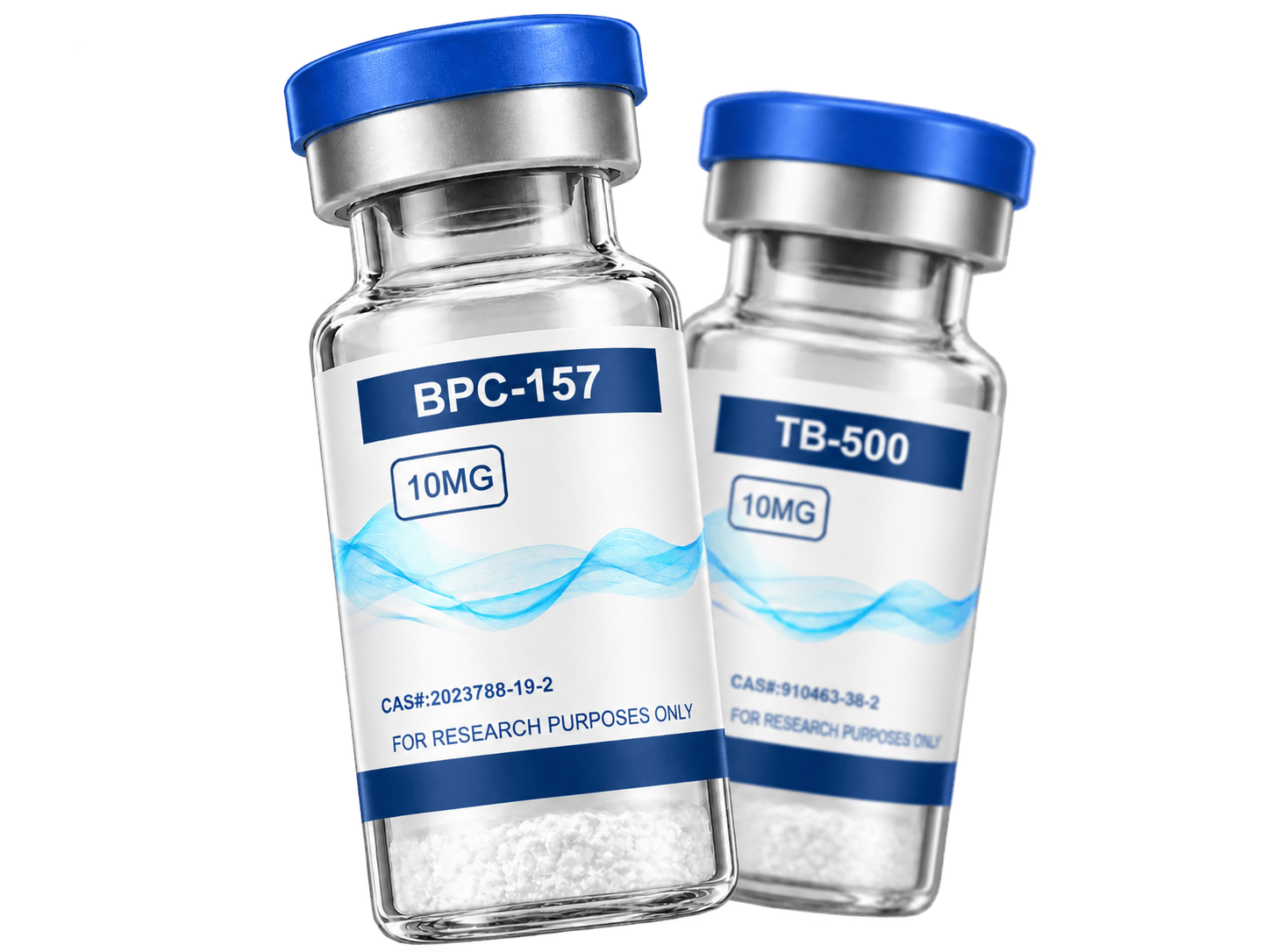

TB-500 is the common research name for thymosin beta-4, a 43-residue peptide encoded by the
TMSB4X gene. Its defining property is simple to state and unusual in its consequences: it binds actin monomers and
does not bind actin filaments.
All products supplied by NexPept are intended for laboratory research use only. Not for human or veterinary use.
Nothing on this page describes, recommends or implies use in humans or animals.
What TB-500 is — and the naming problem you need to know about
Start here, because it determines whether anything else on this page applies to the material in your hands.
“TB-500” is a commercial designation, not a standardised chemical name, and suppliers do not use it consistently. Some sell
full-length thymosin beta-4 — all 43 residues. Others sell a short synthetic fragment built around the actin-binding motif,
typically seven residues or so. Those are very different molecules with very different masses, and they will not behave the same
way in an assay.
What NexPept supplies, specifically: full-length thymosin beta-4. 43 amino acids, molecular weight
4963.44 g/mol, CAS 77591-33-4. That mass is the acetylated form, which is correct — native thymosin beta-4 is
N-terminally acetylated, and the unacetylated version comes in roughly 42 units lower. You can verify this yourself on the
certificate in our COA library before ordering. If you are comparing
suppliers, the molecular weight line on their certificate tells you which molecule you are actually being sold; the product
name does not.
| Common name | TB-500 |
|---|---|
| Compound | Thymosin beta-4 (Tβ4) |
| Residue count | 43 amino acids — full length |
| Molecular weight | 4963.44 g/mol (N-acetylated form) |
| CAS number | 77591-33-4 |
| Gene | TMSB4X — X chromosome, band Xp22.2 |
| Actin-binding motif | LKKTET, beginning at residue 17 |
| Binds | G-actin (monomer), 1:1 — not F-actin (filament) |
| Physical form | Lyophilised powder |
| Format supplied | 10 mg per vial |
| Purity standard | ≥99%, verified by HPLC and mass spectrometry |
| Classification | Cellular research compound |
How actin sequestration works
Actin exists in two states. As individual monomers it is called G-actin, for globular. Joined into long chains it is F-actin,
for filamentous. Those filaments are the cell’s internal skeleton: they hold its shape, and cells move by building filaments at
one edge while dismantling them at the other.
Thymosin beta-4 forms a one-to-one complex with G-actin and binds G-actin but not F-actin. That selectivity is what makes it
interesting. A molecule that bound both would simply coat everything. A molecule that binds only the monomer acts as a
buffer: it holds a reserve of building material in a form that cannot polymerise, and controls how much is free to join
a filament.
Because cells build and dismantle actin continuously in order to move, anything regulating that monomer pool bears directly on
cell migration, which is why thymosin beta-4 appears so often in motility and cytoskeletal literature.
The LKKTET motif, and a common overstatement
The sequence LKKTET, starting at residue 17, is frequently called “the actin-binding motif,” and that shorthand is where the
fragment products come from — if six residues do the binding, why sell forty-three?
The published position is more careful. Research indicates the entire protein length interacts with actin in the complex, not
the motif alone. The motif is necessary but not the whole story. That is the strongest practical argument for working with
full-length material: a fragment reproduces part of the interaction, and which part depends on the fragment.
Research contexts
Published work clusters around cytoskeletal dynamics and G-actin sequestration assays, cell migration work including scratch
and transwell models, in vitro angiogenesis studies in endothelial systems, and integrin-linked kinase signalling.
In our catalogue TB-500 sits under cellular
research, alongside the other compounds studied in tissue and cell-model systems.
How TB-500 compares to the compounds it is grouped with
TB-500 almost never appears alone in supplier catalogues or research discussions. Two comparisons come up constantly, and they
are not equally useful.
Against BPC-157 is the comparison people actually search for, since both appear in similar tissue-model
literature and the two are frequently studied in parallel. Our
BPC-157 vs TB-500 comparison sets them side by side, and the
BPC-157 overview covers that compound on its own.
Against GHK-Cu is a comparison made more by catalogue grouping than by biology. GHK-Cu is a copper complex
studied for extracellular matrix signalling — work happening outside cells. TB-500 binds actin inside them. Our
GHK-Cu vs TB-500 comparison explains why they are less
alike than the shelf placement suggests, and the
GHK-Cu overview covers the copper chemistry.
We also list a combined format: the BPC-157 and TB-500 blend,
5 mg of each, described in the Healing Blend overview.
Worth being straightforward about the trade-off: a blend cannot tell you which component produced an observed effect, so for any
question about a single compound, separate vials are the correct design. Our
guide to peptide blends covers when a combined format is and is not
appropriate.
Regulatory status
TB-500 has no Health Canada authorisation for any use, and is not approved by any comparable regulator. It is not a drug, not a
supplement and not a treatment for any condition.
Thymosin beta-4 and its analogues fall under the World Anti-Doping Agency’s prohibited classes of growth factors affecting
muscle, tendon or ligament. Anyone subject to anti-doping rules should treat it as prohibited. This is stated as a material
fact about the compound, not as guidance: material supplied by NexPept is for laboratory research use only and is not for human
use by anyone.
Handling and storage in the laboratory
TB-500 is supplied as lyophilised powder, stable frozen and markedly less so once reconstituted. Keep sealed vials frozen and
protected from light and moisture, and let a vial reach room temperature before opening so atmospheric moisture does not condense
inside it.
One consideration specific to this compound: at 43 residues it is substantially larger than most peptides in a research
catalogue, closer to a small protein. Larger peptides are more prone to aggregation and to adsorbing onto container surfaces, so
low-binding tubes are worth using and vigorous agitation during reconstitution is worth avoiding. Gentle dissolution is the
practice.
Reconstitution solvent and working concentration follow the protocol of the study being run. Avoid repeated freeze-thaw
cycling, aliquot into single-use volumes, and record lot numbers against runs. Our guide to
peptide stability covers storage and degradation in
detail, and why some peptides reconstitute faster
than others is relevant for a peptide this size.
Verification and certificates of analysis
Every TB-500 lot NexPept lists is tested by an independent third-party laboratory using high-performance liquid chromatography
and mass spectrometry, and the report is published openly rather than offered on request after purchase. Certificates are in the
NexPept Certificate of Analysis library, with the batch number on each vial
matching a published report.
For this compound specifically, the molecular weight line is the one to read first. It tells you whether you have full-length
thymosin beta-4 or a fragment, and that is the single most consequential fact about any material sold under this name. Beyond
that, confirm the batch number matches your vial, that both an identity method and a purity method are reported, that the test
date is recent, and that the issuing laboratory is named.
Our quality standards page sets out how batches are tested and documented,
what research peptides are explains how research-grade material differs
from a drug or supplement, and buying peptides in Canada walks through what to
check before ordering. The broader guide to research peptides in Canada covers
sourcing and regulation.
Full-length thymosin beta-4, lyophilised, batch-tracked, third-party tested by HPLC and MS. Ships from Ontario with same-day
dispatch on orders placed before 2 PM EST.
Related research compounds
BPC-157 vs TB-500The comparison most researchers are actually making.
GHK-Cu vs TB-500Inside the cell versus outside it — why these two differ more than expected.
BPC-157 overviewPentadecapeptide widely used in tissue-model research.
GHK-Cu overviewCopper coordination chemistry and the matrix literature.
Healing Blend overviewThe combined BPC-157 and TB-500 format.
All cellular research →Browse the full cellular research category.
Frequently asked questions
Is TB-500 the same as thymosin beta-4?
In our catalogue, yes — full-length thymosin beta-4, 43 residues, 4963.44 g/mol. Across the
market generally, not always: some suppliers use the name for a short fragment built around the LKKTET motif. Check the
molecular weight on the certificate rather than trusting the label.
What does “actin-sequestering” actually mean?
It binds actin monomers (G-actin) one to one, and does not bind actin filaments (F-actin). That holds
a reserve of monomers in a form that cannot polymerise, buffering how much is available to build filaments. Since cells move by
continuously building and dismantling those filaments, regulating the monomer pool bears on cell migration.
What is the LKKTET motif?
A six-residue sequence beginning at position 17, commonly described as the actin-binding motif. The
description is a simplification: published work indicates the entire protein length participates in the actin complex, not the
motif alone. That is the main argument for working with full-length material rather than a motif-based fragment.
How does TB-500 differ from BPC-157?
Different molecules with different mechanisms, frequently studied in similar tissue models. Our
BPC-157 vs TB-500 comparison sets them out properly; we also
list a combined blend, though separate vials are the correct
choice for any single-compound question.
Is TB-500 approved in Canada?
No. There is no Health Canada authorisation, and it is not approved by any comparable regulator.
Research-grade material is not a drug, supplement or treatment, and is supplied for laboratory research use only.
Does its size change how it should be handled?
Somewhat. At 43 residues it is closer to a small protein than to a typical research peptide, which makes
it more prone to aggregation and to adsorbing onto container surfaces. Low-binding tubes help, and dissolving gently rather than
agitating vigorously is the practice. Otherwise the usual rules apply — frozen, sealed, protected from light, aliquoted to
avoid freeze-thaw cycling.
What purity should I expect, and how is it verified?
NexPept lists TB-500 at ≥99% purity, confirmed by HPLC and mass spectrometry before a lot is listed.
Reports for every batch we have shipped are published in our
COA library, so the certificate is available before you order rather than
after.
How do I know I’m ordering from the real NexPept?
Our only website is nexpept. Sites using similar names are not affiliated with us. Confirm via our
website verification page. Shipping details are on our
shipping policy page and accepted methods on our
payment methods page.
More from NexPept: browse the full research catalogue, read our other
research articles, or check the frequently asked
questions.
All products are intended for laboratory research use only. Not for human or veterinary use. Products are not intended to
diagnose, treat, cure or prevent any disease, and the information on this page is provided for research and educational
purposes only.