
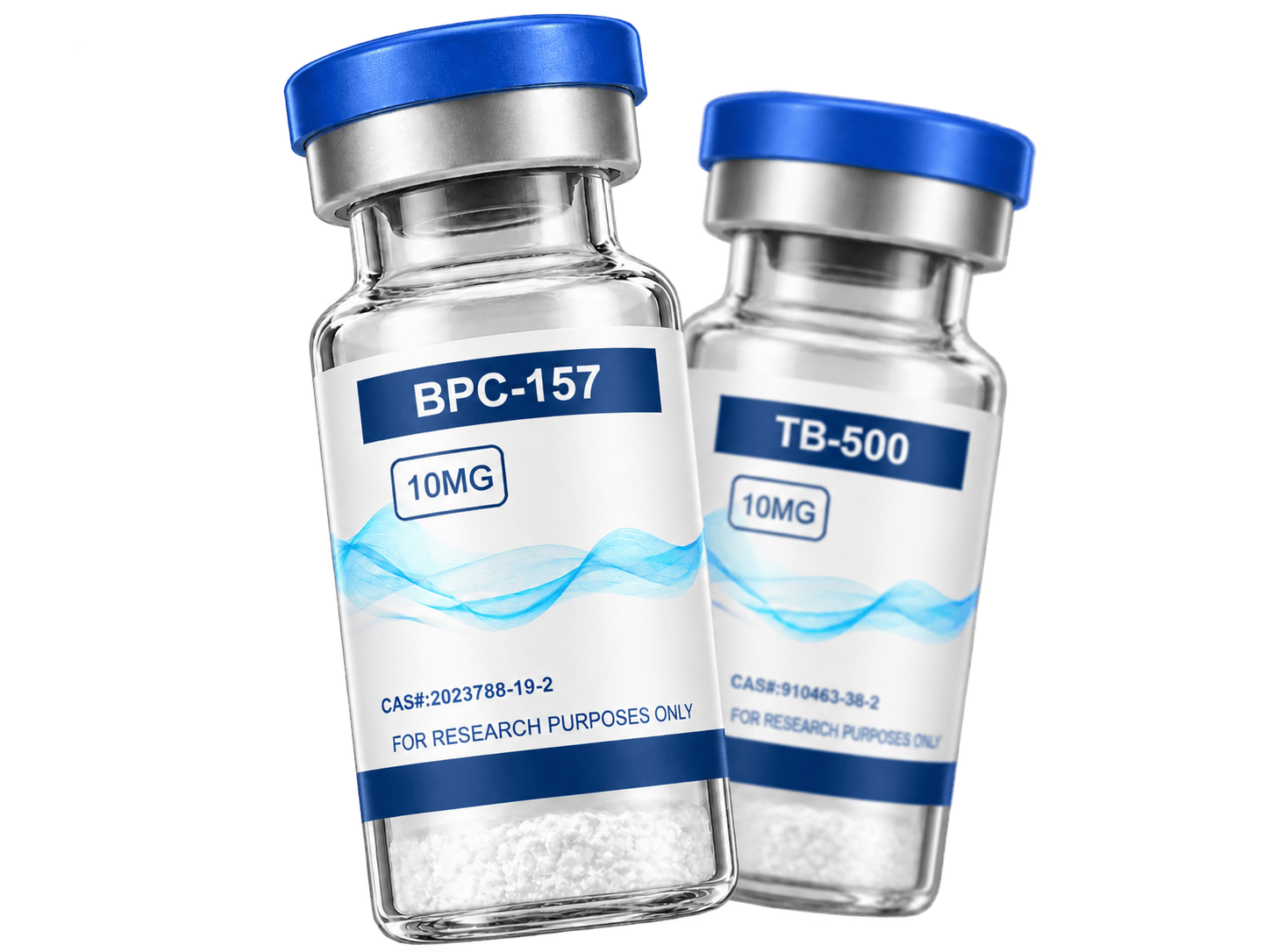
The BPC-157 + TB-500 blend pairs two of the most frequently referenced compounds in the peptide research literature into a single lyophilized preparation. Each has an independent body of preclinical work behind it, and each is studied under a different mechanistic heading — which is precisely why the two are so often catalogued together.
This page is a reference document for qualified research personnel evaluating the blend for in vitro and non-clinical work. It covers what each constituent is at the molecular level, where the two intersect in published preclinical and academic research literature, how analytical documentation should be assessed, and what the current evidence base does not establish. No preparation, dosage, or administration guidance is provided anywhere on this page. For the wider catalogue context, see research peptides in Canada.
Scope note: NexPept supplies peptide compounds strictly for laboratory research use. Nothing below describes a therapeutic application, and no statement here should be interpreted as a clinical or health claim. See the regulatory notice at the end of this page.
What the blend consists of
The preparation contains two synthetic peptides supplied together in a single vial. They are structurally unrelated — different parent molecules, different chain lengths, different registry numbers — and are grouped only because their research literature overlaps.
A synthetic 15-residue sequence (GEPPPGKPADDAGLV) corresponding to a partial sequence of a larger gastric protein. It appears across preclinical and academic research literature in cytoprotection, gastrointestinal, and cellular migration models.
A synthetic fragment (Ac-LKKTETQ) corresponding to residues 17–23 of thymosin beta-4, the actin-binding region of the parent 43-residue protein. It appears in literature concerning actin sequestration and cytoskeletal organisation.
A frequent point of confusion is worth clearing up at the outset: TB-500 and thymosin beta-4 are not the same molecule. Thymosin beta-4 (Tβ4) is a 43-amino-acid protein with its own registry entry (CAS 77591-33-4, MW ≈ 4963 g/mol). TB-500 as supplied in research catalogues is the short active fragment, roughly one-fifth the mass. Literature citations frequently reference the parent protein, so the distinction matters when a study is being mapped onto a specific research material.
Molecular profiles side by side
Both constituents are produced by solid-phase peptide synthesis and characterised by HPLC with mass spectrometric confirmation. The table below sets out the identifiers a laboratory would use to verify material against a certificate of analysis.
| Property | BPC-157 | TB-500 |
|---|---|---|
| CAS Number | 137525-51-0 | 885340-08-9 |
| Molecular Formula | C62H98N16O22 | C38H68N10O14 |
| Molecular Weight | 1419.55 g/mol | 889.02 g/mol |
| Sequence | Gly-Glu-Pro-Pro-Pro-Gly-Lys-Pro-Ala-Asp-Asp-Ala-Gly-Leu-Val | Ac-Leu-Lys-Lys-Thr-Glu-Thr-Gln-OH |
| Chain Length | 15 amino acids | 7 amino acids |
| Compound Class | Synthetic linear pentadecapeptide | Synthetic thymosin beta-4 fragment (17–23) |
| Also Known As | Body Protection Compound-157; PL 14736 | Tβ4 fragment; thymosin beta-4 (17–23) |
| Physical Form | Lyophilized powder | Lyophilized powder |
| Appearance | White to off-white powder | White to off-white powder |
| Analytical Method | HPLC + MS | HPLC + MS |
Verification tip: when checking a batch COA, confirm the observed mass against the theoretical value for the stated formula — 1419.55 Da for BPC-157 and 889.02 Da for the TB-500 fragment. A COA reporting ≈4963 Da under a TB-500 heading is describing full-length thymosin beta-4, which is a different material.
Pathways the two share in literature
Peptide blends are catalogued together when their published research contexts converge. For these two constituents, the overlap sits in cytoskeletal and cellular-movement research models. The headings below describe where each compound appears in preclinical and academic research literature — they are descriptions of research subject matter, not of outcomes.
The two bodies of literature run largely in parallel rather than together. Published work examining the combination as a defined preparation is considerably thinner than the work on either constituent alone — a distinction worth preserving in any literature review that cites blend material.
What the evidence base does and does not show
Accurate characterisation of the evidence is part of good research practice. The following is a plain statement of where the literature currently stands.
What exists
What does not exist
On terminology: descriptive catalogue names used across the research-supply market — "healing blend" among them — reflect the research headings a compound is indexed under, not a demonstrated property of the material. They should not be read as outcome claims.
Purity, batch testing and COAs
With a two-component preparation, analytical variability compounds: a deviation in either constituent propagates into every downstream result. Blend material therefore warrants closer documentary scrutiny than single-compound material.
NexPept publishes batch certificates for catalogue compounds in a single searchable location. Research personnel can cross-reference the batch code on a received vial against the published certificate before material enters a protocol. The same documentation standard applies across every compound in the research peptides Canada catalogue.
Laboratory handling considerations
Handling of lyophilized peptide material should follow the receiving institution's validated standard operating procedures. General laboratory practice for sealed lyophilized material includes:
Note: no preparation, reconstitution, or administration instructions are provided or implied. All handling parameters must be established by qualified research personnel according to the specific experimental protocol in use.
Frequently asked questions
What is the BPC-157 and TB-500 blend?
It is a research preparation containing two synthetic peptides in a single lyophilized vial: BPC-157, a 15-amino-acid sequence (CAS 137525-51-0), and TB-500, a 7-amino-acid fragment of thymosin beta-4 (CAS 885340-08-9). The two are structurally unrelated and are supplied together because their preclinical research literature overlaps in cytoskeletal and cellular-migration models. The material is supplied for in vitro laboratory research use only.
Why are BPC-157 and TB-500 studied together?
Their published research contexts converge on a shared set of experimental endpoints — actin dynamics, F-actin formation, and cell movement in culture — while the underlying mechanisms described in the literature differ. That makes the pairing of interest in research models designed to examine more than one pathway within a single controlled system. Published work on the combination as a defined preparation remains limited relative to the work on each constituent individually.
Is TB-500 the same thing as thymosin beta-4?
No. Thymosin beta-4 is a naturally occurring 43-amino-acid protein (CAS 77591-33-4, MW ≈ 4963 g/mol). TB-500 as supplied in research catalogues is a synthetic 7-residue fragment corresponding to residues 17–23, the actin-binding region (CAS 885340-08-9, MW ≈ 889 g/mol). Because published studies often concern the full-length protein, the distinction should be checked when mapping literature onto a specific research material.
Is this blend authorised by Health Canada?
No. Neither constituent is authorised by Health Canada for human or veterinary use, individually or in combination. The material is supplied exclusively as a laboratory research chemical for in vitro and non-clinical work by qualified research personnel. It is not a drug, food, or cosmetic, and no therapeutic, clinical, or health claims are made for it.
How is purity verified for a blended preparation?
Each constituent is assessed independently by high-performance liquid chromatography for purity, with mass spectrometry confirming molecular identity against the theoretical mass for its formula. Because deviation in either constituent affects the preparation as a whole, both components should carry batch-specific analytical documentation rather than a single combined figure.
Where can I view the certificate of analysis for a batch?
Batch certificates for NexPept catalogue compounds are published in the COA library. Match the batch code printed on the vial against the corresponding certificate to confirm that the documentation applies to the exact material received, rather than to a representative batch of the same compound.
Supplied as lyophilized powder with batch-specific analytical documentation, fulfilled in Canada for laboratory research use only.
View product details →Or browse the full research peptides Canada catalogue →
Research materials referenced on this page
Each compound discussed above is supplied individually as well as in blend format, so a protocol can isolate a single constituent or run the combined preparation. All are supplied as lyophilized powder with batch-specific documentation, for laboratory research use only.
Further multi-component preparations are listed under research blends, and related single compounds under cellular research.
Related research references
- → PubMed — BPC-157 literature index
- → PubMed — thymosin beta-4 and actin regulation
- → Chemical identifiers cross-referenced against Sigma-Aldrich and LGC Standards catalogue entries (CAS 137525-51-0, CAS 885340-08-9).
All compounds and information referenced on this page are supplied and published exclusively for in vitro laboratory and non-clinical research use by qualified research personnel. These materials are not authorised by Health Canada for human or veterinary use. No therapeutic, clinical, or health claims are made.
This material must not be administered to humans or animals. No dosage, preparation, reconstitution, or administration instructions are provided or implied. Nothing on this page is intended to diagnose, treat, cure, or prevent any disease. All handling and use must be conducted by qualified personnel in accordance with applicable institutional policies and legal requirements.
Explore research peptide guides, peptide storage resources, peptide calculator tools, and educational content about research peptides in Canada.