Peptide blends are one of the most misunderstood categories in the research peptide space. If you've browsed a catalog and seen a single vial labeled with two, three, or even four compounds — like GLOW, KLOW, or CJC / IPA — you've seen a blend. This guide breaks down what peptide blends actually are, why laboratories work with them, and what to look for when sourcing them.
All products discussed are intended for laboratory research use only. Not for human or veterinary use.
What Is a Peptide Blend?
A peptide blend is a single vial that contains more than one peptide, pre-combined at fixed amounts. Instead of reconstituting and measuring several separate vials, a researcher works with one standardized vial where the ratio of compounds is already set.
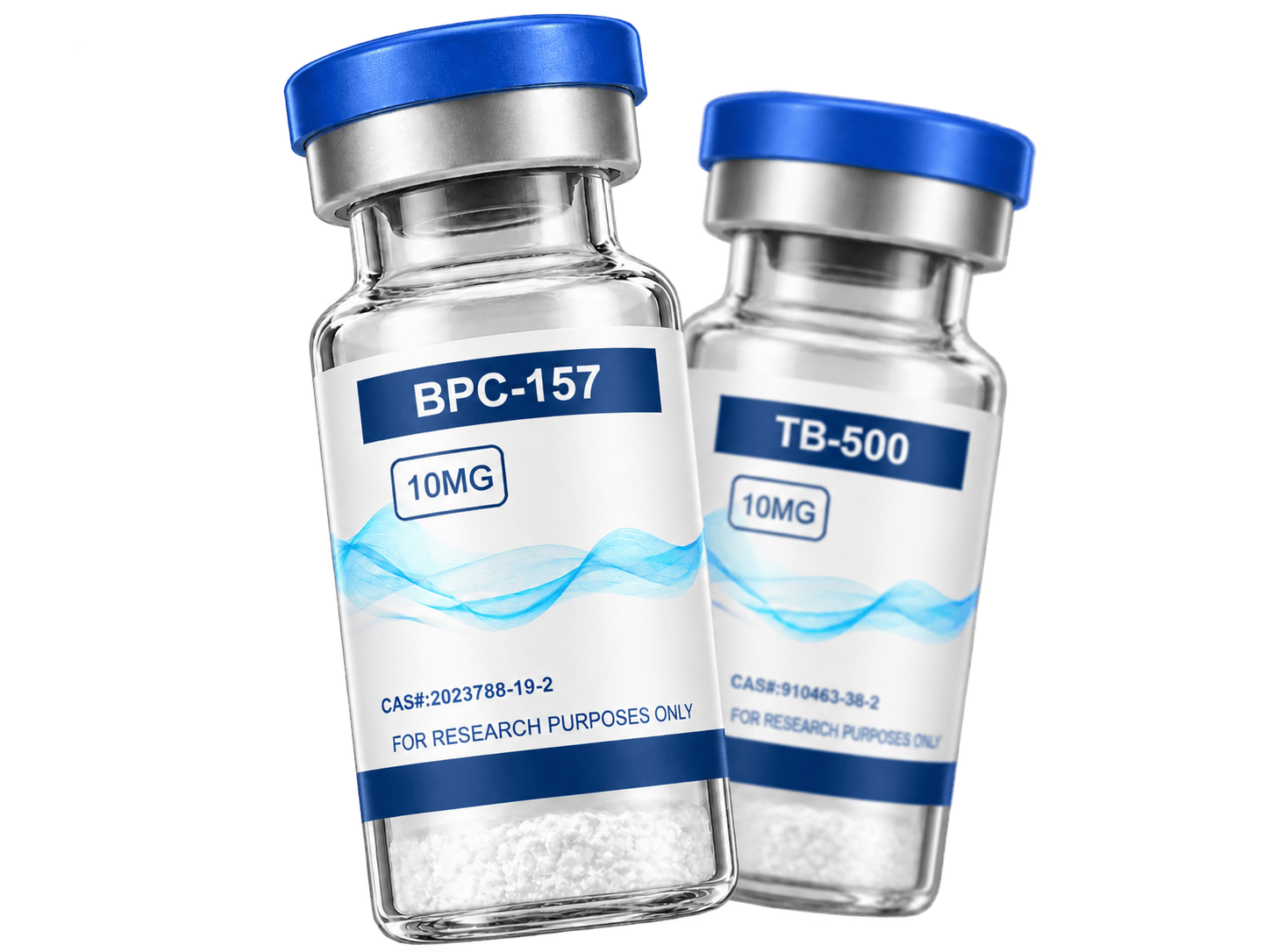
BPC-157 + TB-5005MG / 5MG per vial
CASCustom Blend
That's two peptides, five milligrams of each, in one container. On our labels you'll usually see the components listed together and a "CAS: Custom Blend" designation, because a blend doesn't have a single CAS number the way an individual compound does.
Why Do Researchers Use Blends Instead of Single Peptides?
There are a few practical reasons blends exist:
Standardization
When a study calls for a specific ratio of two or more compounds, a pre-made blend removes the variability of mixing them by hand. Every vial in the batch is identical.
Fewer Variables in Handling
Reconstituting one vial instead of three means fewer steps, less material loss, and less room for measurement error in the lab.
Studying Compounds Together
Much research interest focuses on how peptides behave in combination rather than in isolation. Blends make it straightforward to work with an established grouping.
Cost & Convenience
Buying one blend vial is often more economical than sourcing each component separately, which is why blends are popular in academic and independent research settings.
Common Peptide Blends & Their Components
Below are the blends we carry at NexPept and the compounds inside each. These descriptions are provided for research context only and make no claims about effects in humans.
GLOW
BPC-157 + GHK-Cu + TB-500
Often grouped under recovery and skin research, GLOW combines BPC-157 and TB-500 (both studied in tissue-repair research models) with GHK-Cu, a copper peptide widely used in cosmetic and skin-research applications. GHK-Cu is why the reconstituted solution in these vials typically appears pale blue.
KLOW
BPC-157 + GHK-Cu + TB-500 + KPV
KLOW takes the GLOW grouping and adds KPV, a peptide fragment studied in inflammation-research contexts. It's the four-component version for researchers who want KPV included in the same vial.
CJC / IPA
CJC-1295 No DAC + Ipamorelin
This is a classic growth-hormone-secretagogue research pairing. CJC-1295 No DAC and Ipamorelin are frequently studied together in the literature, which is why they're offered pre-blended at a 5MG / 5MG ratio.
BPC-157 + TB-500
BPC-157 + TB-500
Two of the most-referenced peptides in recovery research, offered together for researchers investigating them as a combined group rather than individually.
Semax + Selank
Semax + Selank
A nootropic-research pairing. Semax and Selank are both studied in cognitive and neuro-research models, and the blend keeps them in a single standardized vial.
What to Look for When Sourcing a Peptide Blend
Because a blend combines multiple compounds, quality and transparency matter even more than with a single peptide. Before buying, check for:
1
A Certificate of Analysis (COA). A reputable supplier provides third-party lab testing showing identity and purity. At NexPept, every product — blends included — is lab-tested with a COA available.
2
Clear component and ratio labeling. The vial and product page should state exactly which peptides are inside and at what amounts (e.g., "10MG / 50MG / 10MG"), not just a marketing name.
3
Purity data (HPLC). High-performance liquid chromatography testing indicates how pure each compound is. Look for purity figures on the COA.
4
Proper storage guidance. Lyophilized (freeze-dried) peptides should be stored cool and dark, and reconstituted material handled per standard lab practice with bacteriostatic water.
Quality & Testing at NexPept
Every peptide and blend we sell is lab-tested, shipped from within Canada, and backed by a Certificate of Analysis. We were also recently featured on Fazier.
Frequently Asked Questions
What does "Custom Blend" mean on the label?+
It means the vial contains a combination of peptides rather than a single compound, so it doesn't carry one individual CAS number. The components and their amounts are listed on the label and product page.
Why is the solution in some blends blue?+
Blends that include GHK-Cu (a copper peptide), such as GLOW and KLOW, typically reconstitute into a pale blue solution. That color comes from the copper complex and is normal.
Are peptide blends tested the same way as single peptides?+
Yes. At NexPept, blends receive the same third-party lab testing and Certificate of Analysis as individual compounds.
Can I buy research peptides and blends in Canada?+
Yes — NexPept is Canada-based, ships domestically, and lists blends alongside single peptides in the catalog.
⚠ DisclaimerAll products referenced are intended for laboratory research use only. Not for human or veterinary use. Nothing in this article is medical advice or a claim of therapeutic benefit.