Thymosin Alpha-1 Canada: Research Peptide Overview
What Thymosin Alpha-1 is, why it has nothing to do with TB-500, why the acetyl group matters more than the purity figure, and how each batch is documented.
Thymosin Alpha-1 is a 28-amino-acid peptide first identified in thymus tissue extract and studied in laboratory settings for its role in immune signalling. Among the compounds in a research peptide catalogue it is unusual in one respect: it has a substantial clinical literature behind it, because it is an approved medicine in a number of countries outside Canada.
Written by the NexPept Research Team · Last updated: October 2026
This guide covers what the compound is, how it differs from the other peptide it is constantly confused with, what its regulatory position actually is, and how NexPept documents each batch. It is an educational overview for laboratory research purposes and is not a dosing guide.
Thymosin Alpha-1 (CAS 62304-98-7, INN thymalfasin) is a 28-residue, N-terminally acetylated peptide derived from prothymosin alpha, originally isolated from bovine thymus extract. NexPept stocks it as a 5mg lyophilized vial, current lot NP-TA1-02 at 99.93% HPLC purity, tested August 17, 2026, with the certificate published up front. It is not the same peptide as TB-500. Research use only; not authorized by Health Canada.
What Is Thymosin Alpha-1?
Thymosin Alpha-1 is a peptide of 28 amino acids with the sequence Ac-SDAAVDTSSEITTKDLKEKKEVVEEAEN. It corresponds to the N-terminal region of a larger precursor protein, prothymosin alpha, and carries an acetyl group on its N-terminal serine — a modification that is part of the native molecule rather than a synthetic addition.
It was first isolated from thymosin fraction 5, a partially purified bovine thymus extract prepared in the 1960s and 70s, and was among the first individual peptides characterised from that mixture. The material supplied today is made synthetically and is sequence-identical to the human peptide; nothing in a current vial comes from an animal.
At 3,108 g/mol it sits in the middle of the size range you will find in a research catalogue — considerably larger than the short bioregulators, considerably smaller than the modified metabolic peptides. If you are new to this category of material, our guide explaining what research peptides are is a useful starting point.
Thymosin Alpha-1 Properties
These are the published identifiers for the compound. Purity and batch values specific to the material NexPept ships are further down.
| Property | Value |
|---|---|
| CAS Number | 62304-98-7 |
| Other names | Thymalfasin (INN); Thymosin α1; Tα1 |
| Compound class | Synthetic thymic peptide; fragment of prothymosin alpha |
| Sequence | Ac-SDAAVDTSSEITTKDLKEKKEVVEEAEN |
| Sequence length | 28 amino acids |
| Key modification | N-terminal acetylation (native, not a synthetic tag) |
| Molecular formula | C129H215N33O55 |
| Molecular weight | 3108.3 g/mol |
| Physical form | Lyophilized powder, white to off-white |
| Available format | 5mg vial |
| Analytical method | HPLC purity, mass spectrometry identity confirmation |
| Regulatory status | Not authorized by Health Canada for human or veterinary use |
Thymosin Alpha-1 Is Not TB-500
This is the single most common confusion around this compound, and it is worth settling before anything else. Thymosin Alpha-1 and thymosin beta-4 are not variants of one another. They are unrelated peptides with different sequences, different lengths, different structures and entirely different research literatures.
The shared name is a historical accident. Both were first identified in thymosin fraction 5 — the same bovine thymus extract — and were named alphabetically by the chromatographic fraction they came out of, not by any structural relationship. Alpha and beta here label where they appeared on a column in the 1970s.
| Thymosin Alpha-1 | Thymosin Beta-4 | |
|---|---|---|
| Length | 28 residues | 43 residues |
| Precursor | Prothymosin alpha | Independent protein; not related to prothymosin alpha |
| Known binding | Studied in immune signalling, including Toll-like receptor pathways | Actin-binding; sequesters G-actin |
| Studied for | Immune modulation and T-cell maturation models | Tissue repair, angiogenesis and cell migration models |
| Sold as | Thymosin Alpha-1, thymalfasin | TB-500 |
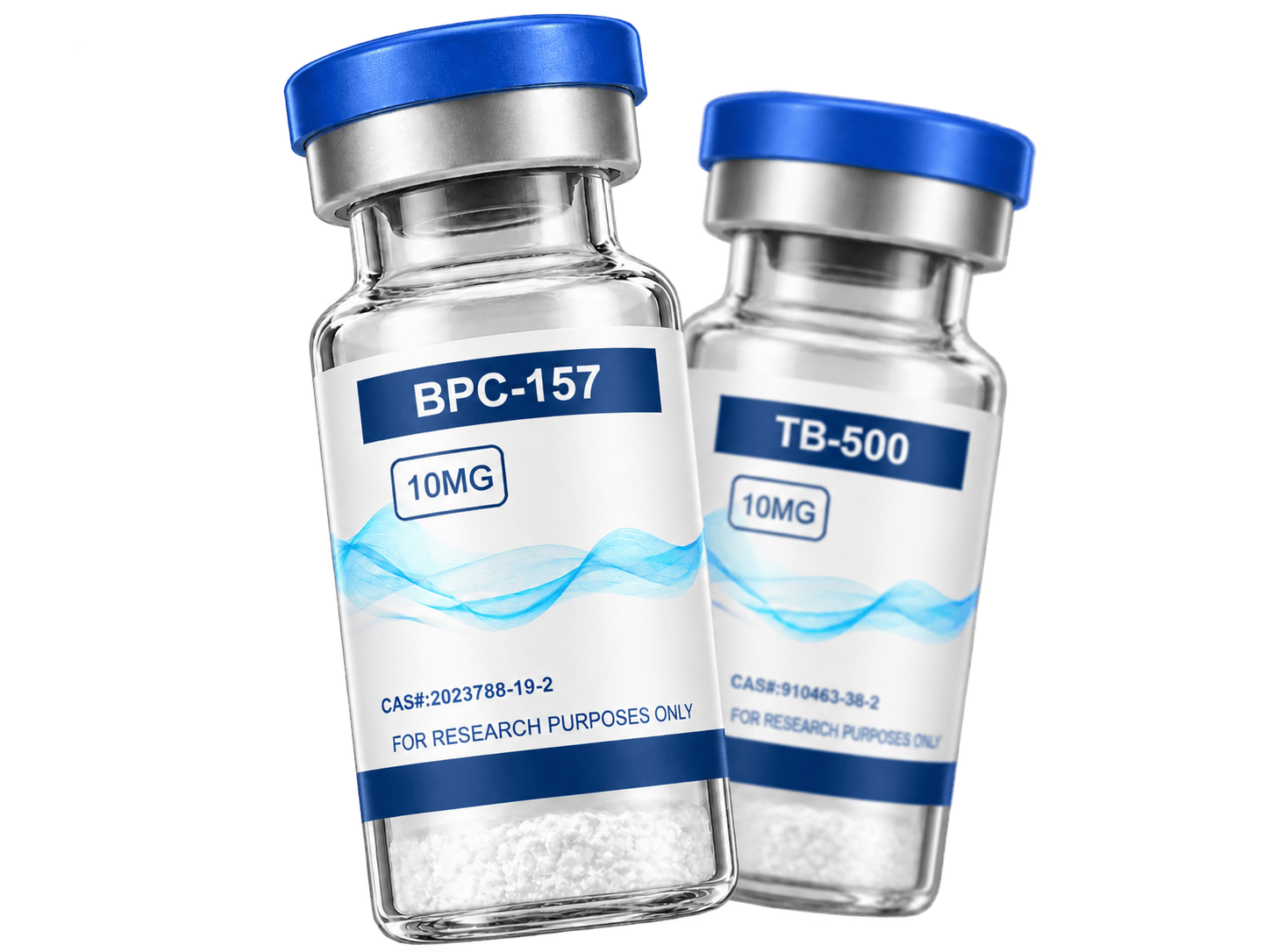
One caution when sourcing: "TB-500" is sold by some suppliers as the full 43-residue thymosin beta-4 sequence and by others as a short active fragment of it. Those are not the same material either, so a certificate that states a molecular weight is more informative than a product name. Both compounds, along with the other immune and repair peptides in our catalogue, sit under cellular research peptides.
Research Focus Areas
In controlled laboratory environments, Thymosin Alpha-1 appears in work on:
- T-cell maturation and differentiation models
- Toll-like receptor signalling, particularly TLR2 and TLR9 pathways
- Dendritic cell activation and cytokine profile studies
- Th1-skewed immune response models
- Immunosenescence and thymic involution research
- Adjuvant studies in experimental vaccine models
Unlike most compounds in this catalogue, a meaningful share of the Thymosin Alpha-1 literature is clinical rather than preclinical, for the reason set out in the next section. That makes the published base broader than usual — but it does not change what the material in a research vial is supplied for, or what conclusions may be drawn from laboratory work with it.
Regulatory Status
Thymosin Alpha-1 occupies an unusual position among research peptides, and it is worth stating accurately rather than glossing over.
Under the international nonproprietary name thymalfasin, it is approved and marketed as a prescription medicine in a number of countries, where it has been through regulatory review and carries an accompanying clinical trial record. That is why the published literature on it is deeper than for a typical research compound, and why its mechanism is better characterised than most.
None of that applies in Canada. Thymosin Alpha-1 is not authorized by Health Canada for human or veterinary use, it is not an approved drug here, and approval in another jurisdiction confers nothing domestically. NexPept supplies it strictly as a laboratory research material. Nothing on this page describes or recommends use in humans or animals.
Purity, Batch Data and Documentation
With this compound there is a specific thing to check, and it is not the purity percentage.
The native peptide is acetylated at the N-terminus, and that acetyl group is part of its identity rather than an optional extra. A 28-residue peptide of the identical sequence without the acetyl group is a different molecule — and it will still report a high HPLC purity figure, because purity measures how much of the sample is the main peak, not whether the main peak is the right compound. The difference in mass is 42 daltons, which an HPLC trace alone will not resolve for you but a mass spectrum will.
So for Thymosin Alpha-1, mass spectrometry identity confirmation carries more weight than the purity number. A certificate reporting 99% purity and nothing about identity has not answered the question that matters here.
"COA available on request" is the most over-claimed phrase in this market. A certificate worth relying on names the testing laboratory, carries a lot number matching the vial in your hand, states the analytical method, and shows the chromatogram rather than a number someone typed. We publish ours instead of supplying them on request, so the material can be checked before an order is placed.
| Format | Batch | Tested | HPLC purity | Report |
|---|---|---|---|---|
| Thymosin Alpha-1 5mg | NP-TA1-02 | Aug 17, 2026 | 99.93% | View COA |
Identity and purity are confirmed by HPLC and mass spectrometry before a lot is listed, and the certificate stays published in our COA library after the batch sells out — so a result recorded against an old lot can still be traced back to its report. All new batches additionally carry endotoxin testing, which is particularly relevant here: endotoxin is itself a potent immune stimulus, so in immunology work it can produce exactly the kind of readout the experiment is looking for, entirely independently of the peptide. The most-ordered products also carry heavy-metal testing.
Storage and Handling
Lyophilized peptide material is comparatively stable, but handling after delivery affects integrity more than most buyers expect. General laboratory considerations include:
- Storage cool and dry, avoiding repeated temperature cycling
- Protection from moisture and prolonged light exposure
- Recording the lot number against your own inventory, so any later question about a result traces back to a specific batch and its report
- Handling under institution-approved protocols, with particular care over sterile technique in cell-based immunology work where contamination confounds the readout
Lyophilized powder is considerably more stable than peptide in solution, and researchers should defer to their own institution's validated protocols rather than a general guideline. More detail is in our guide to storing research peptides. NexPept does not supply preparation, reconstitution or handling instructions; those are determined by qualified personnel under your own protocols.
Sourcing Thymosin Alpha-1 in Canada
Four things are worth checking before ordering anywhere. They apply to any supplier rather than to this compound specifically.
Documentation
Batch-specific reports, published rather than promised, with a lot number that matches your vial. For this compound in particular, check that the certificate confirms identity by mass spectrometry and not purity alone — for the acetylation reason set out above. One generic certificate covering a whole catalogue tells you nothing about what arrived.
Fulfilment
A stated Canadian location and courier. Material crossing the border is subject to customs holds nobody can give you a date for, and spends longer in uncontrolled conditions. Our orders ship from Ontario by tracked Canada Post — details on the shipping page.
Positioning
Research-use framing throughout. This matters more than usual for Thymosin Alpha-1, because its approval as a medicine elsewhere gives careless suppliers an opening to blur the line. A supplier citing foreign approval as though it carried weight in Canada, or offering dosing guidance on that basis, is telling you how the rest of the operation is run.
Pricing
Analytical testing costs money per lot. A catalogue priced well below everyone else has usually removed a cost somewhere, and testing is the easiest one to remove while still describing material as tested. For a wider walkthrough of evaluating a domestic supplier, see our Peptides Canada guide and our guide to buying research peptides in Canada.
Common Questions About Thymosin Alpha-1
What is Thymosin Alpha-1?
A 28-amino-acid peptide with an acetylated N-terminus, corresponding to a fragment of the precursor protein prothymosin alpha. It was originally isolated from thymosin fraction 5, a bovine thymus extract; the material supplied now is made synthetically and is sequence-identical to the human peptide.
Is Thymosin Alpha-1 the same as Thymosin Beta-4 or TB-500?
No. They share the word "thymosin" because both were first found in the same thymus extract and were named for the chromatographic fraction they came out of — not because they are structurally related. Thymosin Alpha-1 is 28 residues and is studied in immune signalling; thymosin beta-4 is 43 residues, binds actin, and is studied in tissue repair. Different peptides, different research.
Why does the acetyl group matter?
The native peptide is acetylated at its N-terminus, and that modification is part of its identity. A non-acetylated 28-residue peptide of the same sequence is a different compound — but it can still report a high HPLC purity figure, because purity measures how much of the sample is the main peak, not whether that peak is the right molecule. The mass difference is 42 daltons, which mass spectrometry resolves and HPLC alone does not.
Is Thymosin Alpha-1 approved in Canada?
No. It is not authorized by Health Canada for human or veterinary use and is not an approved drug here. It is approved as a prescription medicine in some other countries under the name thymalfasin, but approval in another jurisdiction confers nothing domestically. NexPept supplies it strictly as a laboratory research material.
What testing does each batch go through?
Identity and purity are confirmed by HPLC and mass spectrometry before a lot is listed, and the certificate is published with its batch number, purity figure and test date. The current lot, NP-TA1-02, tested at 99.93% on August 17, 2026. New batches also carry endotoxin testing. If a lot has not been tested, it is not sold.
Why does endotoxin testing matter for this compound?
Endotoxin is itself a potent immune stimulus. In cell-based immunology work, endotoxin contamination can produce exactly the kind of activation readout the experiment is designed to detect, independently of the peptide — so for an immune-signalling compound, an untested lot is a genuine confounder rather than a formality.
How should it be stored?
Storage follows your own laboratory protocols. In general terms: cool, dry, sealed, protected from light and moisture, with lot numbers recorded against your inventory.
Key Takeaways
- Thymosin Alpha-1 is a 28-residue, N-terminally acetylated peptide, CAS 62304-98-7, also known as thymalfasin
- It is unrelated to thymosin beta-4 and TB-500 despite the shared name — different sequence, length and research field
- The acetyl group is part of its identity, so mass spectrometry confirmation matters more than the purity figure
- Endotoxin testing is especially relevant for an immune-signalling compound, since endotoxin mimics the readout
- It is approved as a medicine in some countries but not authorized by Health Canada, and is supplied here for laboratory research use only
- The current NexPept lot, NP-TA1-02, tested at 99.93% by HPLC on August 17, 2026, certificate published up front
Source Thymosin Alpha-1 in Canada
Batch-tracked, third-party tested, certificate published before you order, and shipped from Ontario by tracked Canada Post.
View Thymosin Alpha-1 5MGPeer-reviewed literature on this compound is indexed on PubMed, and the full NexPept catalogue of lab-tested compounds is available here.